


Metal detecting is an exciting hobby, which, of course, revolves around discovering hidden treasures and interesting, and potentially valuable, objects. But even the most advanced metal detectors, like the Nokta Legend or Quest V80, have their limits, especially when it comes to precisely locating buried objects. The powerful search coils are ideal for scanning large areas and finding deep-lying treasures. However, once the position of a find has been determined and the search area can be narrowed down to a very small spot, excavating the target can still be a major challenge. This is because the search coil of a metal detector is not suitable for accurately locating a potentially very small object within an excavated hole. This is where pinpointers come in, designed for maximum precision so that the find can be quickly located within the hole. In this article, we'll discuss what pinpointers are, the different types of pinpointers available, how to set them up correctly, and why they are an absolute must-have for every detectorist.
What is a Pinpointer?
A pinpointer metal detector is a compact, handy metal detector that is small and can be held in one hand. Pinpointers are essentially "mini-detectors" designed for the precise localization of finds in the ground and are used by 99% of all detectorists. When a metal object is registered near the tip of the pinpointer, it starts to beep/vibrate. The speed of the beeps or vibrations increases the closer the object is to the device; a continuous tone sounds when in immediate proximity. Some pinpointers have advanced functions, e.g., the Quest XPointer Max (see figure), which emits different tones and LED signals depending on whether the object is ferrous or non-ferrous. In the Magic-Holster-Version, it also has the unique function of automatically going into standby mode as soon as it is placed in the holster and is immediately ready for use again as soon as it is pulled out. Would you like to buy a pinpointer? In our Pinpointercategory, you are guaranteed to find what you are looking for.

Different Types of Pinpointers
There are various types of pinpointers on the market, differing in appearance, functionality, and price. Depending on the intended use, the requirements for the pinpointer also vary. Particularly important features and functions include the following:
- Audio/Vibration: Many pinpointers offer the option to work with vibration signals in addition to audio signals. This is particularly helpful when detecting with headphones or in a noisy environment where the tones are no longer clear enough. Many pinpointers in our range offer this option; simply check the specification list on the product page of the device.
- Waterproof: Some pinpointers are also suitable for searching at or even under water. For example, the Quest XPointer Pro is waterproof up to 60m.
- Display: A few pinpointers have a display that shows signal strength and various settings to simplify operation. For example, the Quest XPointer Max shows the settings, signal strength, and various icons on the display, depending on whether the find is ferrous or non-ferrous.
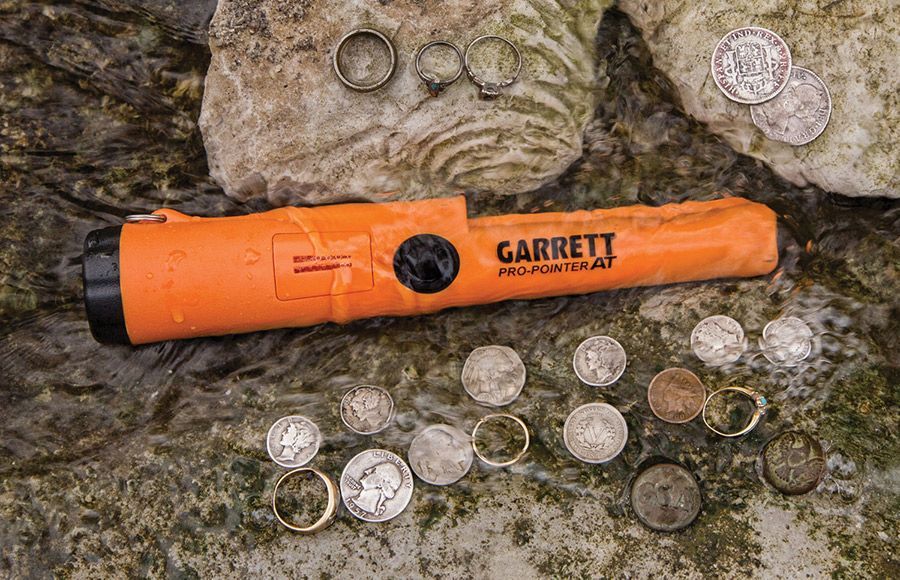
- LED lighting: Many pinpointers, such as the very popular classic Garrett Pro-Pointer AT, have a small LED built-in that illuminates the search area, allowing for searching even in poor light conditions.
- Pairing capability: Some pinpointers can be paired with a metal detector or headphones of the same brand to unlock additional functions. The XP MI-6, for example, can be paired with the XP Deus II, so that the pinpointer's battery level is displayed on the detector's screen, the pinpointer's sensitivity can be adjusted, and the tones can be output via the detector. The soon-to-be-released Nokta Accupoint will also offer the possibility of pairing with metal detectors from the Simplex New Generation or the Legend from Nokta.
How to use a Pinpointer?
Setting up a pinpointer is usually simple and does not require intensive study of the device. These steps are typically followed:
- Turn on the pinpointer: This usually works by simply pressing the button(s) on the pinpointer's housing. ATTENTION: Most pinpointers perform a "ground balance" with the environment directly at startup; they essentially store the signal strength of the environment during startup and only react to objects that emit a stronger signal. Therefore, if the pinpointer is switched on in the immediate vicinity of a metal object, this can reduce the search performance and thus make searching more difficult.
- Search for the object: Move the pinpointer close to the suspected position of the object until it emits a signal. It is usually advisable to poke around in the hole or the excavated soil with the pinpointer to get a signal. If you cannot detect a signal, take your large metal detector again and remove more soil from the hole if necessary.
- Follow the signal: Listen to the audible signal or pay attention to the vibration and visual display. The faster the beeping or vibration, the closer you are to the object. Use these clues to follow the strength of the signal to the target object.
- (Optional) Adjust the sensitivity: Many pinpointers have a sensitivity setting that allows you to adjust the range. In addition, most pinpointers have a "Retune" function, which, when the button is pressed again while a signal is being registered, also reduces the sensitivity until the device is restarted. This allows very large objects to be found more easily afterwards if the pinpointer is already emitting a continuous tone, even though the object has not yet been found.
Do you need a pinpointer?
For these reasons, a pinpointer is practically indispensable for metal detecting:
- Precise localization: With a pinpointer, the position of an object can be determined so accurately that it can be retrieved directly. A proper metal detector with a large search coil does not have the necessary precision.
- Time-saving: Excavating the object is significantly accelerated, as searching for the object without a pinpointer can be very difficult. Finding small objects still encased in soil takes many times longer without a pinpointer.
- Less risk of damage: With a pinpointer, you can carefully approach the object, minimizing the risk of damaging the object through overly aggressive digging.
- Suitable for various environments: Pinpointers work well on the beach, in the forest, and in all other conceivable locations. With a completely waterproof pinpointer, you can even track down finds underwater.
- Minimal interference susceptibility: Pinpointers are significantly less susceptible to things like ground mineralization or electromagnetic interference than metal detectors are, so a pinpointer signal usually results in a tangible find.

THE essential tool for true detectorists!
In short, a pinpointer is an indispensable tool for serious hobby detectorists. Pinpointers increase search efficiency and thus lead to more finds in the same amount of time. This makes detecting trips generally more enjoyable and successful. So don't hesitate to get a pinpointer before you embark on your search for the treasures of the past!

Leave a comment
All comments are moderated before being published.
This site is protected by hCaptcha and the hCaptcha Privacy Policy and Terms of Service apply.